Wednesday, March 27, 2024

Face to the North and Real Sudden Like, Turn Left : Travels to the Illinois Country and the Old Stick Ball Game

  In about a week, we will be heading west. How is it I am heading west? Well, you know...

 I am really excited to get back to Fort De Chartres, a place I have been going since I was around 8 years old. It was the first Colonial event that my dad took me too that I remember vividly. That time so many years ago was for the June Rendezvous. It was everything you expect a rendezvous to be. Plenty of dead animal hats and loads of fantasy impressions of "mountain men", but man, I was hooked. Within the first 24 hours I had made friends with a bunch of the kids in the fort and we formed our own militia and spent the remainder of the weekend running all over the Fort fighting the rival kid militia. What amazing times! 

  This time, I will be heading there with more expensive clothing, more expensive gear and my wonderful wife, but the goal will be much the same. To enjoy and experience good times with goods friends and play at history. 

 One of the great aspects of 18th century living history is the game the natives call "baggatoway" or "the little brother of war". I was introduced to this game early on in my reenacting life at the spring Fort De Chartres event and at Fort Niagara where Gene Tesdahl, or "Henri" as he is known to a great many of us, took me as his little brother and showed me the game. I grew very fond of it and wanted to play at every opportunity. One year, Henri presented me with my very own stick, made of hickory and very thick on the end as he thought my vigorous play demanded it. It's a unique one and very special to me. 

 I don't run like I used to, but I look forward to the ball game at De Chartres in a little over a week. I mostly let the young guys get in there and fight for the ball and stay near the goal and defend. We'll see. 

 I wanted to feature my pal Chris Jones work here as well. He's been making some mighty fine sticks as of late. You can find him on instagram @linensstroudsandduffels 


 Do you have any great stick ball memories? Post them in the comments! 

 
Fort Niagara, 2011


Martins Station 2023

Martins Station, 2023

For Niagara, 2011


Martins Station 2023


Tuesday, March 26, 2024

The Basic Backcountry Kit Part 1: Clothing

 I thought I would jump off the last post and discuss what to my mind is the most basic kit for the Backcountry since that is our focus here. Now this kit will get you through the Spring, Summer and Fall but will not include items needed for the winter months. 

 These items are the most versatile items that can be made or purchased and will allow a number of impressions including, militia, civilian hunter and early war continental line. Note that none of these categories are historical ones, but they are modern and for our purposes. Theres no such thing as a "militia kit" in the period. You brought what you had and in SOME instances you would be provided with some things and so it's important to look at returns and such from the period to determine this sort of thing. It's also important to note that "brought what you had" doesn't mean your giant machine sewn F&I waistcoat worn as an outer garment. 

 The basic kit should include the following : 

  Clothing 

A good round hat shows up so many times in period images and for the backcountry is better suited to the woods than a cocked hat. 


A body shirt, easy enough to procure. Make sure the cuffs are thin. Also a neckcloth or handkerchief. These can be found at Burnley and Trowbridge or the Virginia Floor Cloth Company. 

A hunting shirt. This is the most versatile garment there is and can be worn for militia duty, civilian hunting or Continental Line. A fine hunting shirt has just become available from South Union Mills. 

A few good quotes on the hunting shirt : 

Washington's General Order July, 24th, 1776 "No dress can be cheaper, nor more convenient, as the wearer may be cool in warm weather and warm in cool weather by putting on under-cloaths which will not change the outward dress, Winter or Summer-besides which it is a dress justly supposed to carry no small terror to the enemy, who think every such persona a complete marksmen"

Capt Andrew Holmes Co. 1st Batt. of Cumberland County Militia- 
Hunting Shirt and leggings of a light lye color, striped jacket, good shoes small brimmed hat. Sept 76

"There whole dress is very singular, and not very materially different from that of the Indians; being a hunting shirt, somewhat resembling a waggoner’s frock, ornamented with a great many fringes, tied around the middle with a broad belt, much decorated also…Their hunting or rifle shirts, they have also died in variety of colors, some yellow, others red, some brown, and many wear them quite white (Smyth 179-180)


Trousers are the next versatile piece of clothing and were the blue jean of the period. The working mans garment. South Union Mills also offers these! Click here

A good pair of leggings. We have an article on leggings which you can read here : Leggings
Make sure they fit well. Blue, Red and Green are great colors to start with. 

"Must wear leggings. These are pieces of coarse woollen cloth wrapped round the leg and tied below the knee with a string to prevent the snakes biting you."
-Cresswell Diary 

Buckle Shoes or Moccasins. South Union Mills also carries shoes these days. 

This to my mind is the quintessential backcountry kit when it comes to the clothing. We will get into the gear in the next post! 


Monday, March 25, 2024

If a tree falls in the woods, and nobody is around to hear it, how does documentation get interpreted?

 "He's gonna talk about documentation AGAIN?" Yes...I'm sorry. 

 After doing this blog off and on for a time, I occasionally will get asked for advice from people trying to put together their first "authentic" kit or I'll receive questions about improving on what they have. Frustratingly the advice is rarely followed and after some discourse the person asking will ghost me after I've told him that I can't recommend buying the thing he wanted to buy or making the thing he wanted to make. 

 But a question was posed to me recently in a way that I hadn't thought much about. Unless you've been at this for awhile, research can be daunting. In my experience some folks have an intuitive ability to find good and solid sources and interpret them and others don't. Don't know why this is, but I see it all the time. The question was "If everyone is looking at the same documentation, why does it get interpreted so differently. How is one guy right and the other guy wrong?" Welcome to Protestantism...er, wrong topic. We all have preconceived ideas and notions. But I wanted to take a moment to demonstrate how research moves forward to those who maybe haven't been at this for very long and wonder what all the fuss is about when it comes to documentation. 

 In the 1980s through the 90s, a fellow named Mark Baker took the living history world by storm with his experimental archeology and through his work we really got our first glimpses into a more skills based approach to living history. Not merely dressing up for a parade or to shoot in the primitive area at Friendship but dressing and going out into the wilderness and putting the knowledge, skills, equipment and clothing to the test. This style of living history took on the term "trekking". Mark based his clothing and accoutrements on his research into Morgans Hunters of the 1760s and tried to document what he did to those men. His attempts were good but in a time when the sources available were more difficult to find than simply googling it, some of his choices would be harder to document today or rather the research and our knowledge of 18th century garments have exploded since the dawn of the internet and better access to source material. 

 It should be noted that Mark Baker was not the first to do this stuff, but he was the first to document his experiences in articles and books and so he was the first person to have a wide audience watching him do this stuff. 

 Mark was a pioneer for this hobby. The problem was that most people didn't want to actually examine the source material. They were content to say "Mark Baker did it" and that was all the proof or documentation they needed. It's sort of like when you copy files on computers. You make a copy of the original, then a copy of the copy and then a copy of the copy of the copy and so on until eventually it degrades so badly that it's unrecognizable. That's essentially what people did. There are still guys out there today that have diverged so far from what even Mark was doing that Marks old Muzzleloader articles look current. 

 As you examine the ledgers, paintings and sketches, archeology and extant garments from the 18th century, it becomes more clear that while people like Mark were on the right track, there was still so much to learn. And so others have taken up the mantle and through more thorough investigations different conclusions were brought to light. A consensus starts to be built as more eyes are laid on the source material.  

Below we have two versions of the same person. The first is a person who read some Mark Baker articles, walnut dyed a shirt, rolled his sleeves up over a shirt underneath because he saw Mark Baker do it. The second image is a person who read the actual ledger books and saw the items being bought by Morgans hunters combined with sketches and drawings and archeological evidence from the period and made a more informed choice. Looking at one aspect will never give you the full picture. 


 The person who posed the original question added "How can some people be wrong? Surely they are searching and studying as well." Unfortunately in my experience most folks don't research and study. They just want to have some fun, wear some old timey clothes and go to the woods. Nothing wrong with that either. But, it's all about the approach one takes and the goals one has in mind. 

 If you don't enjoy the research part, I would suggest trusting those who can show you on paper, evidence for what they are doing. If somebody says "I saw someone else do it", then I'd try to steer clear of whatever advice they might give. 


Tuesday, November 28, 2023

Culpepper Minute Battalion, Hunting Shirts and Duck Pouches

 Time to muse again. Maybe if I do, Kobuck will write another useful article that tells you how to do stuff. 

I've been throwing myself into some research of Culpepper Minute Battalion. I've been falling in with the recreated NWTA unit since I was a teenager and recently there has been a push within to try steering into some more updated research or rather, better interpretation of the research that has been there all along. So I've been enjoying looking through Greg Sandors amazing compendium "Journal of the Public Store at Williamsburg 1775-1776". 

 One of the real problems with these "militia" style battalions is we tend to think that "brought from home" means "anything I have laying around becomes fair game" or "wearing just a waistcoat works cause that's all I had. I'm just a poor farmer after all". Getting ourselves further away from this founders day pageant costume approach to living history where everything was homespun and your wife sat weaving her own cloth in the cabin and updating to a view of the incredible economy and vast resources of the 18th century even on the frontier is a struggle. 

 We know from the records they received a lot of oznaburg and linen for hunting shirts. Initially it was thought that these shirts were a pullover style smock. Original recreated Culpepper units would dye them or make them out of green linen or cotton and paint or stitch in big letters LIBERTY or DEATH on the front. It looked cool, but more recent scholarship on the hunting shirt seems to indicate a split front, caped shirt with Liberty or Death embroidered on the breast as a more likely option. 

 
Culpepper Minute Battalion 1996

"We encamped in Clayton's old field (at Catalpa, the home of Philip Clayton). Some had tents, and others huts of plank, &c. The whole regiment appeared according to orders in hunting shirts made of strong brown linen, dyed the color of the leaves of the trees, and on the breast was worked in large white letters the words, "Liberty or Death"! (Green, p.13)


The more plausible appearance of the Minute Battalion Hunting Shirt 

 Another thing we see in the records is a lot of cloth being purchased for leggings with Stroud being reserved for officers of the battalion. 

 Captain William McLanahans company received "49 yards of Blue thicks for Legings" while receiving "best blue stroud for officers".


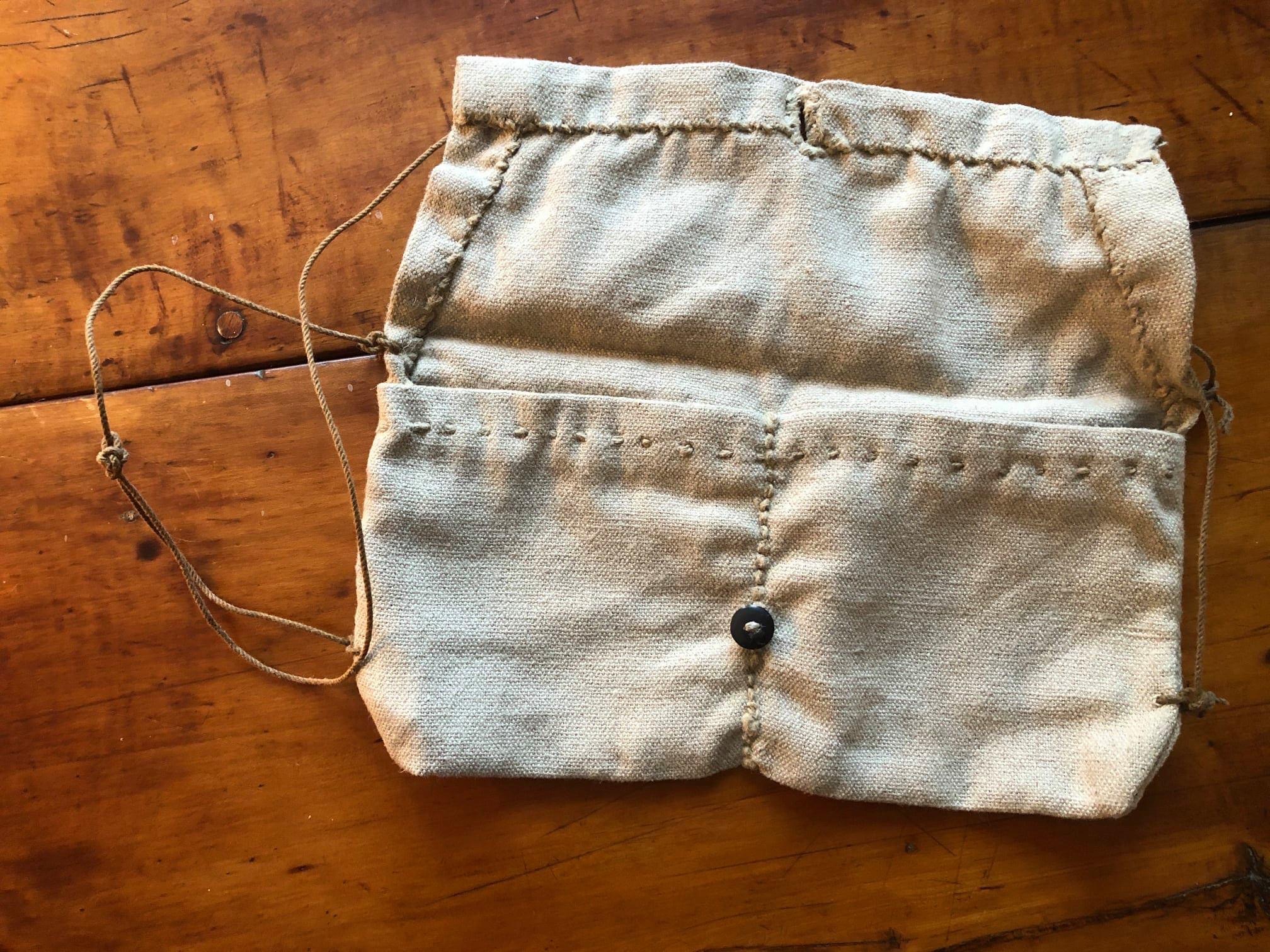
 Another cool aspect that I've at present never seen anyone carry is the duck shot pouch. In October of 1775 the battalion received "88 yds of stout duck for pouches".

 This pouch would fit the bill and was probably a cheap source to get guys supplied with a way to carry ammunition. The following example was made by Adam HL based on an original. 


 There are so many cool details one could bring to this impression and I hope more effort will be made to dispense with the "brought from home" catch all militia impression to something a bit more representative of what we find in the sources. 

 This brought from home idea, the homespun etc should be contrasted with what we actually know about the availability of goods in the backcountry or at the edge of the frontier. In Virginia in the early 1770s, John Hooks store is a prime example. In her book "Buying in the the World of Goods", Ann Smart Martin writes the following :

"The quality, variety and fashionability of the items he stocked belie the pervasive currently held notions of rugged, self-sufficient, backcountry life ; his customers could thumb through the Spectator or  Johnsons Dictionary and handle Backgammon boards, china tea cups and feather plumes."

 She goes on to list an incredible amount of items and goods that certainly turn the homespun rugged frontiersman narrative on its head. It's not that in some places and in some cases this ruggedness didn't exist, we just need to be careful and specific about when, where, who and what when we are portraying something in history. 

In the case of Culpepper's, these men would have been aquanted with the "fashionability" of life in 1770s Virginia and it would reflect in their clothing and accouterments and items "brought from home".  


Monday, May 15, 2023

Did you come here in a wagon? And other fun reasons to justify your impression


         Just returned from a weekend of catching up with friends and making new ones at the newly formatted Martins Station spring event. There was a lot of great conversations and talks given about frontier life. Two of them that I really enjoyed was given by Nathan Kobuck of the Buffalo Trace 1765 blog and the other by Simeon England in which each talked about the gear of two particular occupations or limited occupations, that of the Longhunter/Market Hunter and the Militia man of the Revolutionary period. Both talks brought up two basic ideas, one, that I'll return to in another post and one that will be the focus of this post, being that as you dig into what makes your persona tic, it's important to go to sources and to understand the wider and broader context of the time period and how it relates to what you're trying to portray. To understand other industries and the economy that these people took for granted by virtue of living it everyday, and how we also take for granted our own time and the ways in which we interact with commerce and everyday commodities. 

    When I was listening I was reminded of a comment made once and one I've heard as an argument to sort of say that theres no real reason to improve an impression. "Did you come here in a wagon? Well then you must not be that authentic." This comment is meant to suggest that if you're not able to completely recreate the conditions of 18th century life, to travel by horse to an event, catch a period disease or live in a cabin with no running water or electricity then somehow you shouldn't offer up any critiques or that since those conditions aren't possible to meet we should throw out all expectations and by extension justify all manner of items documentable or not. It's a line of logic I do not follow. 


    I would therefore like to discuss some things and admit to some things during this post that might help you. I very much tailor my level of immersion to the event. This past weekend at Martins I camped in a "modern" sun forger canvas tent. I kept a cooler behind the tent covered with a blanket that contained our food as well as cans of Coca Cola. Inside my tent was a plastic tub and a modern backpack and fiddle case. Typically at a public event, depending on the scenario, I will lessen the expectations on myself to be this uber authentic person.  HOWEVER, one thing I will not compromise on is what I carry and wear on my person. This is completely and totally under your control. Getting to an event in a wagon, or suddenly not having a modern food pallet is not exactly easy and in most cases impossible. I know after an event the first thing I do is go get fast food because I've been jonesing for it after a weekend of grazing on parched corn, bread and cheese. We are modern people and that is OKAY. But what is not okay, in my mind, is using my need for a cheeseburger after an event to justify wearing a giant antler handle knife made out of a file, or modern glasses or shoes.

    So here are some things to think about or rules of thumb that I use and questions I ask before attending an event. 

    What am I going to be doing at the event? What is my purpose for attending? What is my role in it? 

     If I'm with my unit or we're doing a special thing, I know to prepare for living out of a knapsack and probably sleeping on the ground or in a building with a whole bunch of other people. But if I'm going to be camping with just me and Eileen and we are just hanging for a weekend at a laid back public event like Martins or Vincennes in a couple weeks, we'll bring along some small comforts. What doesn't change though is what I wear and what gear I use. When I walk away from my modern sun forger wedge tent with a cooler of Coca Cola, what I have on my person is the important part. Our plan is though to eventually go from sun forger to a linen tent within the next year or two. Pacing yourself is a good thing. 

    And as a brief side tangent, don't let your gear and clothing not being up to snuff keep you from attending an event. There's great opportunities to learn and most people if you're willing to take the time and put in the effort are more than happy to help you. 

    My philosophy has morphed over the years. At one time I was basically campaigning at every event, not bringing a tent just roughing it every way I could possibly think. But at some point I felt like I needed to take an event by event approach about how "hardcore" I want to be with my camping situation. 

    What shouldn't change though is our commitment to nailing those things we can completely control and that is what we choose to put on and carry on our body to represent the people of the past. If you didn't show up to an event in a wagon, that doesn't make you a farb. But if you use not showing up in a wagon to justify wearing a sleeveless waistcoat over a long shirt, well....


Saturday, December 31, 2022

Why Hand Sewing should be the least of your worries

     Before I start this post, I should say that it's going rile a few folks. To the progressive types I might be preaching a heresy, and to the people who care less about what they wear and more about what they do, this might seem like I'm letting you off the hook. That I've finally seen the light and I don't care about the details anymore. Well, you're both wrong. So without further ado...

Michael Ramsey and Myself at Locust Grove. Micheal is one of the finest 18th century tailors in the hobby today. If you can afford his work, I highly recommend. 


There was and has been a major push in the last decade and a bit to move the hobby in the direction of hand sewn garments from head to toe. An admirable goal and I applaud those who make this commitment.         

    But, it is my opinion that hand sewing your clothes should be somewhat low on the priority list. 

    There's several reasons people list for not hand sewing their clothing. Money, time and not having the ability to sew. Money tends to be a bit more scary than it actually is. You can often find people in the hobby that will sew a garment for a reasonable price. Some folks will charge high prices, but the work is good so, I guess if you want that level of work, go for it. But suffice to say, it can be daunting. Not having the ability to sew and learning how can also be a daunting task when you're first starting out and of course theres the time aspect. Hand sewing takes a lot of time, and if you're not particularly efficient then sewing can take up huge chunks of it. 

    Now, stopping here, I just want to say. YOU SHOULD LEARN TO HAND SEW. At least so you can make some items or make repairs to clothing. But do you need to become the next bespoke tailor in the hobby?  No. 

    Theres a final aspect that I think is valid and that is, maybe you simply don't enjoy sewing. It might not be your thing. And that's okay. 

    So what should your priorities be? If it isn't hand sewn what should you be striving for? 

    First, the right materials. Choosing the correct materials. Correct materials will be the building block of the proper look. 

    Second, patterns and the right cut are crucial to achieving a period look. 

    Machine sewing, while frowned upon in some circles, will help you get in the field quickly and save you a lot of time. Machine sewn interiors will never be visible to the public or your fellow reenactors, however, anything visible should be hand sewn. I think this is a happy compromise to make. 


My shirt is hand sewn, but my jacket and trousers are machined on the inside with hand finishing 

    My kit is about 60-40 Machine to Hand Sewing. And I'm okay with it. Hand sewing has never been my cup of tea. I get really frustrated with it. So I usually buy second hand, order a machine sewn/hand finished garment, or if the price is right, something entirely hand-sewn. 

    So, what am I saying? Learn to sew. That's the best option. But if it's not your thing, it's okay. There's options. A completely hand sewn kit is cool and admirable, but I usually don't like being told someones kit is hand sewn. Feels like an invitation to stroke an ego. That's cool, your kit is hand sewn, but can you build this fire in the rain so we can stay warm? No. Also fine, but let's not act like anyone is cooler than anyone else here. 

    At the same time, not being able to hand sew yourself is not an excuse for making up whatever fantasy garment or ill fitting thing you can find wear because "People did with what they had" or "Out on the frontier they didn't know about the latest fashions" . Again, cut and fit are the key. 


Monday, December 19, 2022

Christmas Gambols


A few passages relating to the festivities around this time of year. 


Christmas is come, hang on the pot,

Let spits turn round, and ovens be hot;

Beef, pork, and poultry, now provide

To feast thy neighbors at this tide; 

Then wash all down with good wine and beer, 

And so with mirth conclude the Year.

-Virginia Almanac (Royle) 1765


 Our boy Nick Creswell writes of a twelfth night party : 

"There was about 37 Ladys Dressed and Powdered to the like, some of them very handsom, and as much Vanity as is necessary. All of them fond of Dancing. But I do not think they perform it with the greatest elleganse. Betwixt the Country Dances they have What I call everlasting Jiggs.

A Couple gets up, and begins to dance a Jig (to some Negro tune) others comes and cuts them out, these dances allways last as long as the Fiddler can play. This is social but I think it looks more like a Bacchanalian dance than one in a polite Assembly. Old Women, Young Wifes with young Children on the Laps, Widows, Maids, and Girls come promsciously to these Assemblys which generally continue til morning. A Cold supper, Punch, Wine, Coffee, and Chocolate, But no Tea. This is a forbidden herb. The men chiefly Scotch and Irish. I went home about Two Oclock, but part of the Company stayd got Drunk and had a fight."

 Also from Phillip Vickers Fithian in 1773 : 

"Guns are fired this Evening in the Neighbourhood, and the Negroes seem to be inspired with new Life."

 In 1772, the Virginia Almanac observed :

"This Month much Meat will be roasted in rich Mens Kitchens, the Cooks sweating in making of minced Pies and other Christmas Cheer, and whole Rivers of Punch, Toddy, Wine, Beer, and Cider consumed with drinking. Cards and Dice will be greatly used, to drive away the Tediousness of the long cold Nights; and much Money will be lost at Whist Cribbage and All fours"


If you have anymore quotes, please leave some comments! Hope everyone has the merriest of Christmas feasts, warm drink and good company.