Showing posts with label Leggings. Show all posts

Wednesday, May 28, 2025

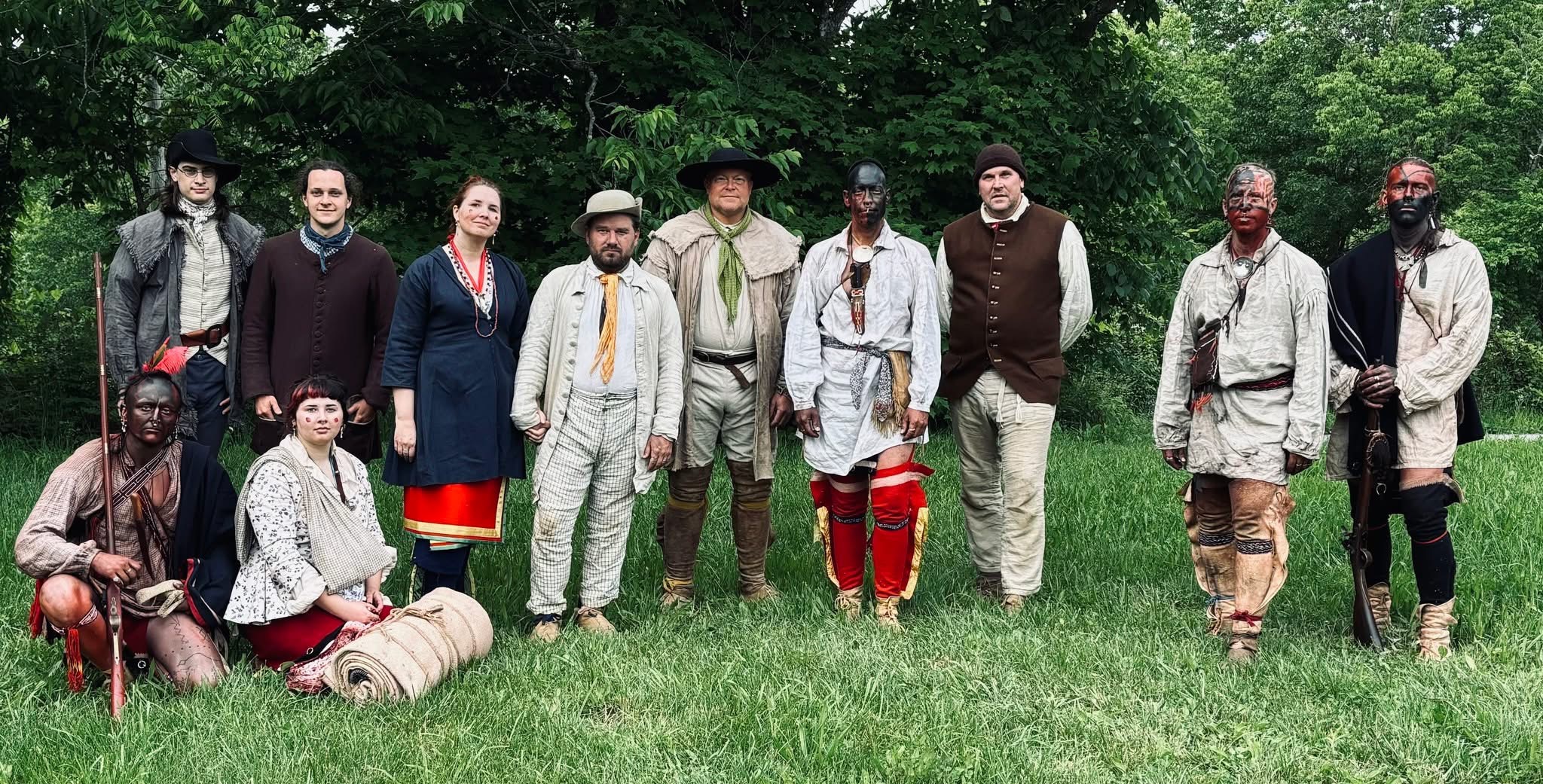
Dark and Bloody Ground : Immersion Recap


I’m never exactly sure how to write these immersion recaps. Should I simply tell it as it happened? Should I write it as though it’s an 18th-century narrative, straight from the Draper Manuscripts? I never know. So I suppose I’ll do a little of both—maybe. We’ll see how it goes.

After traffic delays and some van battery issues, I finally arrived on site late Thursday evening. David and Dillon were already there and had gone into the woods. Elijah had arrived as well, and he and I quickly kitted out and went looking for our native counterparts. We spent the first night camped together, and by the next day the rest of our parties had arrived.

By mid-afternoon Friday, the hunting party was assembled and in the woods: five men total—myself, Elijah, Joshua, Ehrin, and Sayer. Elijah had brought some green deer hides, and he and Sayer set about making frames to stretch and hang them. While they worked, Joshua, Ehrin, and I began construction on the half-face shelter. We had one good felling axe, several belt axes, and a crosscut saw.

Work was going well when suddenly natives were spotted on the ridge above. Our camp was, admittedly, poorly placed. We sprang to our rifles and managed to drive them off. After that, we became more vigilant.

Later, I went to the spring for water and was ambushed by the native party. I managed to escape when the rest of my group came to my aid. We made a second attempt at dusk, but they had crept closer to camp and sprang an ambush. The fight that followed was intense and close-quarters—in the darkness, we could see them only by the flashes from their firelocks.

I passed a sleepless night, cold and uncomfortable. In the early hours, Elijah and I rose and built a small fire, keeping a watchful eye on the ridge. As the rest of the party stirred, we warmed salt pork over the fire and resumed our work through the morning.

While sitting on the back log of our half-face shelter, I spotted a native watching our camp from the underbrush. I slowly stood and walked to my rifle. Just then, fire erupted from the trees, accompanied by war cries. We sprang into action. Elijah crossed the dry creek and cut off any attempt at flanking. We formed an open line and began exchanging fire. I shouted, “Let’s show them what Virginians are made of!” and with that, we charged. They fell back a short distance and took up positions behind trees. At one point, I was just ten feet from one of them. It was close and intense, but we finally drove them off.


As we returned to camp, we saw one of the natives run down and grab our felling axe where Joshua had been cutting wood. With the axe gone, work on the shelter slowed considerably.

Later, while Joshua and Ehrin scouted up toward the spring, the natives realized our group was divided. They rushed our camp and quickly encircled us in their usual half-moon formation. We fought for our lives. After about ten minutes, Ehrin and Joshua broke through the native line and rejoined the fight. Elijah and I flanked to the left, and I pushed up to the ridge, expecting to find the enemy. To my surprise, I was alone.

Eventually, I stumbled upon the native camp—and there was our felling axe. I took it back, along with a tobacco pouch, and returned to camp with my prize.

   At this point, all the hides were on frames and scraped, and we’d made good progress on the half-face shelter. We were low on powder, so I decided to go parley with the natives. Upon arriving at their camp, it was decided I would be “captured” and taken above our camp to deliver a message: we were not welcome in Kentucky. And that’s how it ended.

It was a truly incredible weekend. So many vivid moments added to the realism—not just the skirmishes, but the quiet times in camp, the work on the hides, and the sounds of timber being chopped. From their perspective, hearing us in the woods deepened the experience.


One of the most special moments was having my dad come down and sit in camp for a while. It was a dream come true for him to see us doing this on his property, and I’m glad he could be part of it. We all camped together the last night with Eileen and Colleen joining us, went out for a group dinner and reminisced about our epic weekend and made plans for the future. 

I'm also glad that we had several relatively new guys, and they're more fired up about living history than ever.

This won’t be the last!  


Monday, August 7, 2017

"to ape the manner of savages . . ." or if James Bond was 18th century frontier what he might of looked like


"Declarant states that he was then stationed at Fort Pitt, the place aforesaid.  Declarant states that in obedience to the order of his said Captain Brady, he poceeded to tan his thighs and legs with wild cherry and white oak bark and to equip himself after the following manner, to wit, a breechcloth, leather leggins, moccasins and a cap made out of a racoon skin, with the feathers of a hawk, painted after the manner of an Indian warrior.  His face was painted red, with three black stripes across his cheeks, which was a signification of war.  Declarant states that Captain Brady's company was about sixty four in number, all painted after the manner aforesaid."  George Roush pension papers.  Early 19th century, describing 1777 campaign


"As we enlisted our men, we dressed them uniformly in the Indian manner, with breech-clouts, leggins, mockesons and green shrouds, which we wore in the same manner that the Indians do, and nearly as the Highlanders wear their plaids.  In place of hats we wore red handerchiefs, and painted our faces red and black, like Indian warriors.  I taught them the Indian discipline, . . . "  James Smith,  LIfe and Travels of Colonel James Smith.   1799 describing the "black boys" of the 1760's


"It was the silly fashion of those times for the riflemen to ape the manner of savages . ."  John Henry, An Accurate and Interesting Account of the Hardships and Suffering of that Band of Heroes, Who Traversed Thru The Wilderness in the Campaign Against Quebec in 1775.  1812


" April 10th. 1758 SIR Yesterday in the afternoon as Mr. Miller & 2 or 3 Countrymen more was riding from here to Jenkins's about 4 miles from this, they were fired at by Cocks & Lane who was lying under the fence, the Countrymen came in on a full gallop and inform'd me that they were fired on by some Indians. I immediately sent out Lieut. Weedon with a Command of Men who followed their Tracts till dark, returning home I sent Ensign Chew out again this morning to Reconnoiter on the other side the Mountain where he fell on their Tracts, and after pursuing them about 10 Miles he found a Beef that they had killed and cut out the Toungue and part of the hind quarters, he continued following them about a Mile farther and discovered a smoke in the hollow of a Mountain, Coming nigh perceived them Bacueing their Meet, they being acquipt every way like Indians and as he had followed their Tracts from pretty near the place where Lt. Weedon left them last night had great reason to believe they were Enemy/and immediately fired on them. Lane was killed Dead and Cocks mortally wounded, they brought to Bells Fort where he left him with a Sergt. & [manuscript torn] Men, he confessed it was their own fault & blame know one else but themselves for the Accident.1 I am Sir Your mo obt. Servt. J. BAKER"


“Lane and Cox appeared to have been disguised as Indians, and it was under the impression they were such that Lieutenant Chew shot them.”—Washington to President Blair, April 17, 1758


"400 Virginian Volunteers, all armed with rifles, and excellent marksmen, dressed alamode de sauvages, with painted shirts and fur caps stained with paint" Scots Magazine, Oct of 1764


"…8 blankets, 7 yards of stroud for making britch cloth and leggings, and 4 shirts for the volunteers of Kentucky" Clark Papers, 1992-2-656-658-July 1, 1779

"Capt. Hugh McGarry request to conductor of store for 20 blankets, 20 shirts, and 9 yards of blue stroud for 20 men of his company of Kentucky volunteers." Clark Papers, 1866-2-573-574-July 5, 1779.

"Honble. Sir: An unlucky, but unavoidable accident happened in the neighborhood of Patterson's fort the other day. The proceedings of an examining court of officers on that occasion (which are herewith sent) will bring your Honor acquainted with the circumstances. I caused a very strict enquiry to be made into the conduct of Mr. Chew, that equal justice might be done to the dead and to the living; and it appeared that Mr. Chew had acted with great spirit and activity in pursuing the tracks of those people; and that in shooting them (altho' it was unlucky in the event) he had done nothing that was not strictly warrantable, Lane and Cox appearing both in dress, disguise and behavior, to be no other than Indians."  JOHN BLAIR Fort Loudoun, April 17, 1758.

"I have had the happiness of seeing Captain Michael Cresap marching at the head of a formidable company of upward of one hundred and thirty men from the mountains and backwoods, painted like Indians, armed with tomahawks and rifles, dressed in hunting-shirts and moccasins; and though some of them had traveled near eight  hundred miles from the banks of the Ohio, they seemed to walk light and easy, and not with less spirit than at the first hour of their march."  Anonymous letter to Philadelphia, 1775


"Joseph Neal a soldier in Col' Rawling's Regiment was brought before the Court on suspicion of Deserting. Denies the Charge. No proof appearing against him & the suspicion arising only from Cutting one of his Ears & painting like the savages."  General court-martial, Col. Stephen Bayard, President Washington Papers.


"Pryor and Hammond were dressed in the Indian style . . . . . . . They passed the Indians without being recognized"  Extract from Hugh Taylor's "Notes".  Frontier Advance on the Upper Ohio, 1778-1779


I'm just going to let the quotes speak alone on this post.  Basically white dudes aping Indians.  Whole companies of them, a pair of buddies, spies . . . As cool of an impression as can be had . . .

And a huge, huge THANK YOU to Fred Lucas.  The man is bottom less pit of awesome resources and research.  99% of this stuff came from him.  Thanks a ton!


Fred Lucas, "the Frontier Yoda"


Sunday, July 23, 2017

Breech-clouts and Leggins...or...Let's Get the Basics Right!


 "On their legs they have Indian boots, or leggings, made of coarse woolen cloth, that either are wrapped around loosely and tied with garters, or are laced upon the outside, and always come better than half way up the thigh . ."  -J. Smyth,  Tour in the United States of America


"we dressed them uniformly in the Indian manner, with breech-clouts, leggins mockersons and green shrouds . . "  -J. Smith, Life and Travels of Colonel James Smith


"The rest wear breechclouts, leggins and hunting shirts . ."  -Journal of Nicholas Cressell


"instead of stockings they wear Indian leggings . ."  -Travels of Johann David Schoepf


"Deerskin leggings were fastened at the top to a body belt on which the scabbard would also be attached.  The leggings were then tied around below the knee."  -Nathan Boone interview in the Draper manuscripts


"It was the silly fashion of those times for the riflemen to ape the manner of savages . ."
"By-and-by Morgan came, large, a commanding aspect, and stentorian voice.  He wore leggins, and a cloth in the Indian style."  -J. Henry, An Accurate and Interesting Account of the Hardships and Sufferings of That Band of Heroes, Who Traversed Thru The Wilderness in the Campaign Against Quebec in 1775


All of the above quotes are in the context of white dudes in the back country wearing leggings, and several include a breech clout as well.  And this is just the tip of the iceberg.  There are TONS of quotes describing this, but my favorite thing isn't to sit in front of a computer and type, so I will hope those quotes will be sufficient for the purposes of this post.
The question that naturally follows is, what exactly are "Indian leggings"?  And what does a correct breech clout look like?


"They go without any covering for the thigh, except that before spoken of, round the middle, which reaches down half way the thighs; but they make for their legs a sort of stocking either of skins or cloth; these are sewed as near to the shape of the leg as possible, so as to admit of being drawn on and off.  The edges of the stuff of which they are composed are left annexed to the seam, and hang loose for about the breadth of a hand: and this part which is placed on the outside of the leg, is generally ornamented by those who have any communication with Europeans, if of cloth, with ribbons or lace, if of leather with embroidery and porcupine quills curiously colored."  -J. Carver, Travels through the Interior Parts of North America in the Years 1766, 1767, and 1768


"Above the moccasin all the Indians wear what are called leggings, which reach from the instep to the middle of the thigh.  They are commonly made of blue or scarlet cloth, and are formed so as to sit close to the limbs, like the modern pantaloons; but the edges of the cloth annexed to the seam, instead of being turned in, are left on the outside, and are ornamented with beads, ribands, &C., when the leggings are intended for dress.  Many of the young warriors are so desirous that their leggings should fit them neatly, that they make the squaws, who are the tailors, and really very good ones, sow them tight on their limbs, so that they cannot be taken off, and they continue to wear them constantly till they are reduced to rags.  The leggings are kept up by means of two strings, one on the outside of each thigh, which are fastened to a third, that is tied around the waist.  They also wear round the waist another string, from which are suspended two little aprons, somewhat more than a foot square, one hanging down before and the other behind, and under these a piece of cloth, drawn close up to the body between the legs, forming a sort of truss. The aprons and this piece of cloth, which are all fastened together, are called the breech cloth."  -I. Weld, Travels through the States of North America


I'll start with the breech clout.  A strip of wool stroud (a decent quality broadcloth is a great choice for the modern living historian), historically about 8 to 12 inches wide and somewhere around 50 ish inches long.  Adair says they are " a quarter of an ell wide, with an ell and a half long . ." which comes out to 11" by 68".  This is much longer than other descriptions and period images of them, as well as all original examples I am aware of.  In period imagery they seem to end around mid thigh on front and back both.  Some shorter than that, very few longer.  Blue predominates the color choice.  Red comes in second.  But basically strip of WOOL that goes tucked between the legs, up over a waist tie of some sort, then hangs over like an apron in front and back.

 A quick word about "hourglassed" breech clouts - don't do it!  For what ever reason it's become popular in the living history world to cut the middle part of breech clouts into an hour glass shape, tapering in a semi circle shape on either edge.  I suppose the idea is to do away with extra material and make them more comfortable.  This extra material gets tucked up around your junk though, and keeps everybody from seeing more than they want to.  So don't do it!  Not cause it's farb (it is) but because I don't want to see that much of any other dude.  Also, stick with wool.  Broadcloth.  Stroud with a list if you can afford it or have the fortitude to make it yourself.  Stay away from linen.  Good wool.  (I've rocked my wool clout more than once in 100 degrees plus and high humidity for days on end and found it rather pleasant.  You can too!)


Leggings.  Another piece of clothing, much like a breech clout in that it is incredibly simple - but so much wrong in the world of living history.  Imagine a rectangle of wool, once again broadcloth or stroud, or BRAINTAN (german tan doesn't cut it, it looks like german tan, not Indian dressed skin) that will be folded in half hot dog bun style, and the leg of the wearer slipped down it it.  It goes from the ankle to anywhere from just above the knee to mid thigh.  It is sewn with a running stitch down the outside of the leg.  Sewn with a running stitch TIGHTLY to the leg.  Baggy leggings scream 1990's bad reenacting.  So sew them tightly.  A good way to do this is sit on the floor, legs stretched out in front, put the wool around your leg and either staple them down or make a chalk line.  Then go back and follow the staples sewing and pulling staples as you go, or follow the chalk line.  I leave about a 6 inch section at the ankle not sewn so as to be able to slip them on and off.  If sewn tight all the way down, they can be all but impossible to put on and take off.  Hooks and eyes down there is a way to close them (and historically correct!) as is wrapping with wool tape or a braintan wang.  I wear my moccs flaps up so that takes care of the opening for me.   The leggings should retain a flap around 4 ish inches that run down the outside of the leg.  They should also be worn with garters.  (Garters are a whole other subject, but stick with wool tape, brain tan wang, or correctly done finger woven ones.  Thick wool yarn is a huge red flag so don't do it when it comes to garters.  I'm unaware of a single pair of quilled garters that are original to the 18th century)  Garters should be tied above the calf, below the knee.  Not above the knee on the thigh.  (Why do I even need to say this?  Because I've seen the facebook pictures . . )  Leggings also have a strip or strap (or two in a y shape) that goes up from the top, along the outside of the thigh and ties to a belt or waist thong to help hold them up.  Wool colors are once again - blue.  red.  green.  white.  And a few other weird ones but not as common as those.

Last but not least, a smattering of period images of Indian leggings and breech clouts, a long with a few original examples.


-Matthew Fennewald-